Summary of How to Use Your Phone Abroad Without Racking Up Roaming Charges
- Avoid surprise roaming bills with a practical breakdown of carrier add-ons, local SIMs, and travel eSIMs.
- You land in a foreign country, flip off airplane mode, and your phone connects to a local network within seconds.
- A detailed breakdown of how international roaming charges work from the Federal Communications Commission makes clear that rates vary widely by carrier and destination, with some reaching $10 to $20 per megabyte of data.
You land in a foreign country, flip off airplane mode, and your phone connects to a local network within seconds. It feels effortless. The problem arrives weeks later, buried in your carrier statement: a roaming surcharge that was invisible until it was too late. Hundreds of travelers get hit by surprise international charges every year, and nearly all of them could have avoided it entirely with a bit of prep before departure.
Connected Abroad: Five Things That Actually Matter
- Without an international plan, some carriers charge $10 to $20 per megabyte of data.
- Carrier day passes run around $10 per day and make sense only for very short trips.
- Local SIM cards cut costs sharply but require a carrier-free phone and a physical swap.
- Travel eSIMs are the most flexible option for modern phones not tied to a specific carrier.
- Check your phone's carrier restriction status and eSIM support before your departure date.
Why Your Phone Bill Can Spiral the Moment You Cross a Border
Your smartphone never really goes idle. It checks email, syncs photos, refreshes apps, and pulls map data in the background constantly. At home, that traffic falls within your plan. Abroad, on a foreign partner network, every megabyte costs your carrier a wholesale fee. Without an international plan active, that cost gets passed directly to you.
A detailed breakdown of how international roaming charges work from the Federal Communications Commission makes clear that rates vary widely by carrier and destination, with some reaching $10 to $20 per megabyte of data. A quick Google Maps session uses around 5 MB. Scrolling through Instagram for a few minutes can burn 20 MB or more. Multiply that across a week of casual use and the charges compound fast.
Voice calls on standard roaming typically run $1 to $3 per minute. Incoming texts can cost $0.25 or more each way. Even receiving a short message costs money. All of this kicks in automatically the moment your phone hands off to a foreign carrier's towers, which happens as soon as your home network's coverage disappears.
Carrier Day Passes: Convenient but Expensive Over Time
What this means for Use Phone Abroad Without Racking Up
Every major US carrier now offers some version of an international day pass. AT&T's International Day Pass costs $10 per day in over 200 countries and gives you the same high-speed data and calling rates you get at home. Verizon's TravelPass follows the same $10-per-day model. T-Mobile includes low-speed international data on its Magenta and Go5G plans, though speeds are capped at 128 Kbps, which barely handles text-based messaging.
For a one or two-day cross-border trip, a day pass is genuinely practical. There is nothing to buy, nothing to configure, and the daily cost is predictable. You use your phone normally and pay a flat rate per day used.
The problem is the math on longer stays. A week at $10 per day adds $70 to your bill, on top of your regular monthly plan charge. Two weeks comes to $140. Three weeks hits $210. Travelers also report forgetting to disable the add-on after returning home, paying for days they never used internationally. For any trip lasting more than five or six days, a carrier day pass stops being a convenience and starts being a significant unnecessary cost.
Local SIM Cards: The Best Rates, but the Most Work
Buying a prepaid SIM card from a local carrier at your destination has long been the budget traveler's answer to international connectivity. In the UK, a prepaid SIM from a carrier like Three or Giffgaff costs 5 to 10 British pounds and includes several gigabytes of high-speed data. In Japan, tourist-oriented data SIMs run roughly 3,000 to 5,000 yen for up to 30 days. Across much of Southeast Asia, a local SIM with 15 to 20 GB of data can cost the equivalent of $5 to $10 USD.
The savings are real. The friction is also real. Your phone must not be restricted to your home carrier's network. Not every carrier removes that restriction automatically. Some require a formal request and a waiting period before you travel. Then you physically remove your home SIM and replace it with the local one, which means storing a tiny card safely for the entire trip.
You also lose access to your regular phone number for the duration. That creates headaches for two-factor authentication codes that arrive via SMS. If you use SMS-based codes to access banking apps or work accounts on the road, a SIM swap can lock you out at a critical moment. Some countries add a passport registration requirement to activate a prepaid SIM, adding yet another step at the airport. If you land late at night in an unfamiliar city, hunting for a working SIM card is the last thing you want on your plate.
Travel eSIMs: Data Flexibility Without Touching Hardware
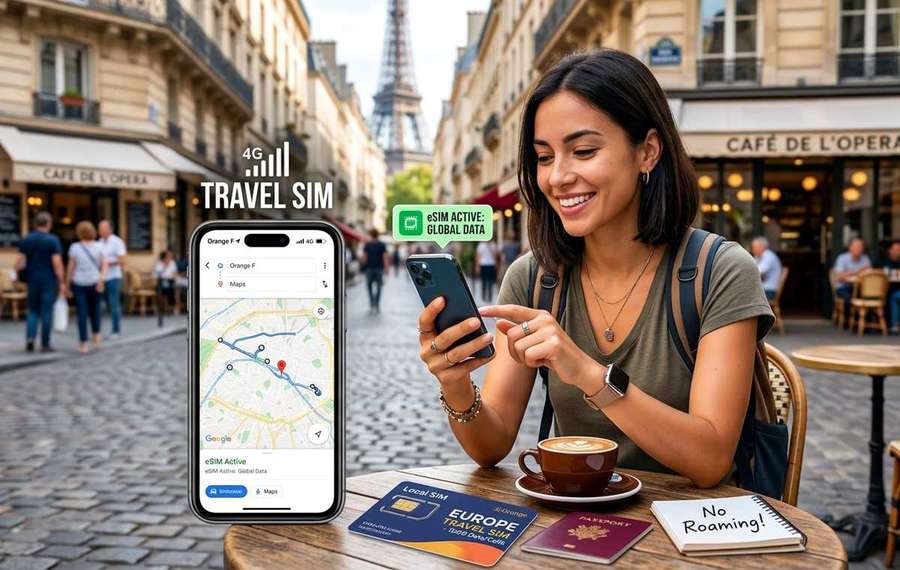
An eSIM is a SIM card embedded directly into your phone's hardware rather than existing as a removable plastic chip. Instead of visiting a store or swapping physical cards, you download a carrier profile over the internet and activate it through your phone's settings menu. Most modern phones can hold multiple profiles at once, meaning a travel eSIM can run alongside your existing home SIM at the same time.
That dual-SIM capability is the defining advantage for international travelers. You run a travel eSIM for data while your home SIM stays active for calls and texts on your regular number. Your contacts can still reach you. Your authentication codes still arrive. You never disappear from your own phone number for the duration of the trip.
Here is what makes the travel eSIM approach genuinely attractive: iPhones from the iPhone 14 onward are eSIM-only in the US market. Most recent flagship Android phones from Samsung, Google Pixel, and other major manufacturers also support eSIM. Mid-range Android devices are increasingly eSIM-capable as well. If your phone was purchased in the past two to three years and is not locked to your carrier's network, there is a strong chance it is ready to go.
- Purchase and activate a data plan entirely from your phone, days before your flight even departs.
- Your home phone number stays live for calls and texts throughout the trip.
- Regional bundles cover multiple countries under a single plan, with no mid-trip switching or repurchasing.
- Per-gigabyte costs run far below what carrier day pass rates charge for equivalent data.
Travel eSIM providers offer prepaid regional data plans at rates far below carrier day pass pricing. A 10 GB regional Europe plan from a major provider typically runs $20 to $30 for two weeks of coverage. Compared to AT&T or Verizon day pass rates, that represents a potential saving of over $100 on a two-week trip. The setup process for install travel eSIM on your device takes under five minutes and requires no store visit or physical hardware swap.
The consistent caveat: most travel eSIM plans are data-only. Voice calls go through your home SIM or through internet-based apps like WhatsApp or FaceTime audio. For most leisure travelers, that arrangement is perfectly practical. For people who need to receive calls on a specific number at predictable times, it is worth factoring into the decision.
Preparing Your Phone Before Departure
A short checklist before your trip prevents the kinds of problems that only surface when you are standing in a foreign airport with a bag in each hand and a delayed flight on the board:
- Carrier restriction status: On iPhone, go to Settings, then General, then About. The Carrier Lock field should say "No SIM restrictions." On Android, the path varies by manufacturer but typically lives under Settings, About Phone, or Network settings.
- eSIM support: On iPhone, go to Settings, then Cellular, and check for an Add eSIM option. On Android, look under Connections or Network in Settings, depending on your device brand.
- Data roaming toggle: Know where this setting lives in your phone's menu. Disabling it before boarding is a failsafe that stops background app traffic from triggering foreign charges.
- Two-factor authentication: If any critical accounts rely on SMS codes for verification, switch those accounts to an authenticator app like Google Authenticator or Authy before the trip.
Matching Your Option to Your Trip Length
A one or two-day cross-border trip is where a carrier day pass earns its keep. The predictable $10 to $20 total cost and zero setup effort make it the rational choice for short stays where simplicity matters more than savings.
For trips lasting three to seven days, a travel eSIM pulls ahead on value. A regional data plan at $20 to $30 beats the equivalent in daily add-on charges, and there is no per-day billing cycle to monitor. You pay once and the data lasts the trip.
For trips of eight days or more, the financial case for carrier day passes collapses entirely. A two-week trip on carrier day passes adds $140 in roaming fees. A travel eSIM for the same duration might cost $20 to $30. That gap covers a restaurant dinner or a museum entry for two, not a carrier's roaming markup.
Travelers visiting multiple countries on a single itinerary benefit most from regional eSIM bundles, which cover an entire continent or broad geographic area under a single purchase. You cross borders without buying new plans, contacting your carrier, or touching any hardware at all.
Your Next Trip Deserves a Better Connectivity Plan
International connectivity does not need to be stressful or expensive. Carrier day passes cover short trips where convenience outweighs cost. Local SIM cards serve budget-focused longer stays where the savings justify the physical setup. Travel eSIMs serve modern phones with no carrier restriction, giving the cleanest combination of local data pricing and an always-available home number.
The worst outcome is doing nothing and letting your phone roam on standard rates, checking the damage when you get home. The best outcome is spending ten minutes before departure setting up a data plan that costs less for two full weeks than a single night's hotel stay. Sort your connectivity the same way you sort your power adapters: handle it before you board, and it becomes one less thing to think about once you arrive.