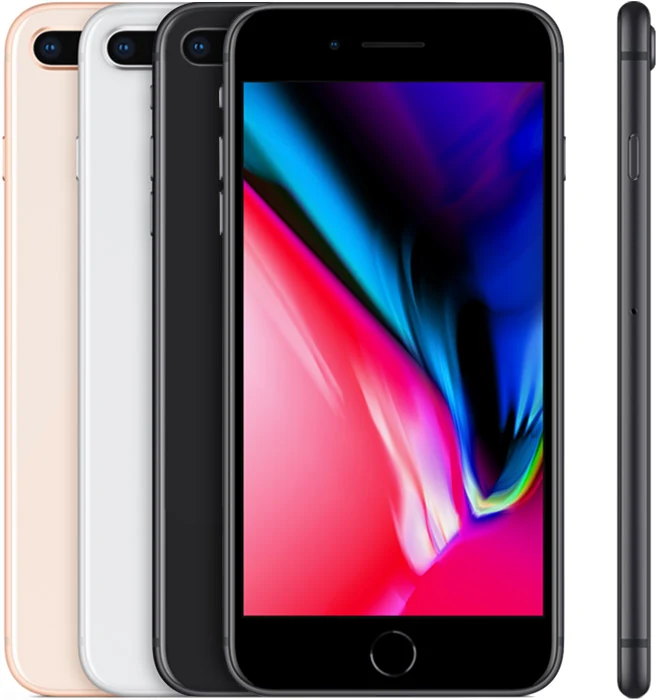
iPhone 8 Plus review summary
- The iPhone 8 Plus is a solid choice if you want a large iPhone with a Home button, dual cameras, and wireless charging. Its A11 Bionic chip is fast, and the glass back allows for Qi charging. However, the screen resolution is low for the price, and the glass back is fragile and expensive to repair. It is best for users who prefer Touch ID and want a dual-camera iPhone without paying for the iPhone X.
- Super-fast A11 Bionic processor
- Dual cameras with Portrait Lighting
- Wireless charging support
- IP67 water resistance
- No headphone jack
- Glass back is costly to repair
- Relatively low-resolution screen with big bezel for the price
Editorial verification: MobileBurn editors verified the device specifications, ownership details, and material review findings before publication.
Design and Build: Glass Back, Same Front — Apple iPhone 8 Plus
The iPhone 8 Plus marks a clear departure from the metal unibody design of its predecessor. The most obvious change is the new glass back, a glossy panel that Apple claims is the most strong glass ever used on a smartphone. In practice, this gives the phone a more premium feel and better grip than before, though it also attracts fingerprints and can slip from your hand more easily, especially when using the phone one-handed.
The front of the device is nearly identical to the iPhone 7 Plus, with the same large bezels, the familiar Touch ID home button, and a Lightning port at the bottom. That also means there is no headphone jack. The phone is water-resistant with an IP67 rating, offering protection against splashes and brief submersion. Available in Silver, Space Gray, Gold, and Red, the 8 Plus weighs slightly more than its predecessor, though the difference is not very noticeable in daily use.
One important consideration is that the glass back is costly to repair if it cracks, so handling it with care is advised.
Display: True Tone LCD with Big Bezels — Apple iPhone 8 Plus
What this means for Apple iPhone 8 Plus
The iPhone 8 Plus features a 5.5-inch Retina HD LCD display with a resolution of 1920 by 1080. While this is the same resolution found on the iPhone 7 Plus, the new screen adds a feature called True Tone, which adjusts the white balance based on the ambient lighting. This makes the display appear more natural and easier on the eyes in different environments.
The screen offers strong brightness and color accuracy for an LCD panel, but for the price, the resolution is relatively low compared to many competing smartphones with higher pixel densities. The large bezels above and below the screen also look dated next to more modern designs. The phone still relies on a 60Hz refresh rate, which is standard for the time but feels less fluid than higher refresh-rate screens available today.
Overall, the display is functional and pleasant for everyday use, but it is not as sharp or new as what you might find in newer, more expensive phones.
Performance: A11 Bionic and the Neural Engine — Apple iPhone 8 Plus
Under the hood, the iPhone 8 Plus is powered by Apple's A11 Bionic chip, a six-core processor featuring two high-performance cores and four efficiency cores. This processor delivers impressive benchmark results and a significant performance boost over its predecessor, with Apple promising gains of 30 to 70 percent depending on the application. The three-core GPU is the first fully designed by Apple, and it supports the Metal 2 graphics API and an AR engine for augmented reality apps.
The A11 also includes a Neural Engine, a dedicated block for machine learning tasks. While at launch this feature had limited use—mainly assisting with scene recognition in the camera app—it lays the groundwork for future machine learning integrations through Apple's CoreML API. The phone comes with 3GB of RAM, compared to 2GB in the smaller iPhone 8, and is available with either 64GB or 256GB of internal storage. This hardware ensures smooth performance in everyday tasks, gaming, and augmented reality applications.
However, the LTE modem is not the fastest available, which may affect mobile data speeds in some areas.
Cameras: Dual Lenses for Portraits and AR — Apple iPhone 8 Plus
Behind the iPhone 8 Plus, you get two 12MP cameras: one standard wide-angle lens and one telephoto lens for 2x optical zoom. This setup lets you take Portrait mode shots with blurred backgrounds, and Apple's Portrait Lighting adds studio-style effects like contour or stage light. The dual cameras also make the iPhone 8 Plus better for augmented reality than the smaller iPhone 8, as the telephoto lens helps with depth sensing.
While the image quality is strong in well-lit conditions, the screen's relatively low resolution means you won't see every detail as sharply as on higher-end displays from the same year. For users who want a large iPhone with a Home button and dual cameras, this remains a capable choice.
Battery and Charging: Wireless and wired Options — Apple iPhone 8 Plus
Apple brought wireless charging to the iPhone for the first time with the 8 Plus. The glass back enables Qi-compatible chargers, such as those from Mophie or Samsung, though initial wireless charging speeds are slower than using a standard Lightning cable—roughly two-thirds the speed. A later firmware update was promised to enable faster wireless charging. The phone also supports fast wired charging if you use a compatible adapter. The battery can last up to 14 hours of video playback, which is similar to previous Plus models.
Keep in mind that the glass back is fragile and expensive to repair, so careful handling is advised when placing the phone on a charging pad.
Is the iPhone 8 Plus right for you? — Apple iPhone 8 Plus
If you want a large iPhone with a Home button, dual cameras, and wireless charging, the iPhone 8 Plus is a solid pick. Its A11 Bionic chip is fast, and the glass back allows for Qi charging. However, the screen resolution is relatively low for the price, and the big bezels make the phone look dated compared to newer models. There's also no headphone jack, and the glass back is costly to repair.
This phone is best for users who prefer Touch ID and want a dual-camera iPhone without paying for the iPhone X. Use our phone finder to see other options, or compare it directly with the smaller iPhone 8 in a side-by-side comparison.
Use the phone reviews to check the next practical option.