Summary of Galaxy Z Fold 8 drops Flex Mode: Why the new hinge changes everything
- The Galaxy Z Fold 8 removes Flex Mode because its new hinge snaps fully open after 75 percent, making unfolding easier.
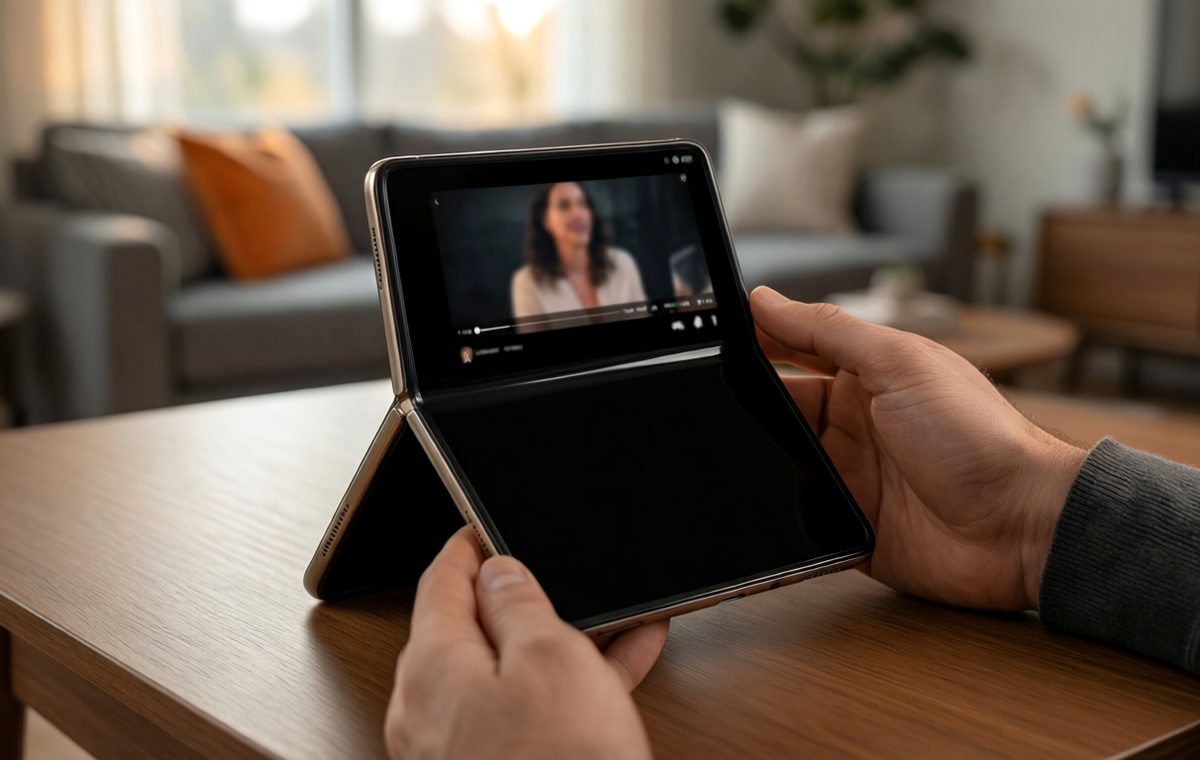
- Tent mode — propping the phone like a tent with the cover screen facing up — replaces Flex Mode for hands-free video watching.
- Only the Galaxy Z Fold 8 Ultra retains Flex Mode support for users who need the virtual trackpad and split-screen software.
- The 16:10 cover screen and quick-opening hinge encourage more use of the 7.6-inch folding display.
- A poll found only 9 percent of voters considered the lack of Flex Mode a dealbreaker.
Goodbye Flex Mode, hello snap-open hinge
When Samsung unveiled the Galaxy Z Fold 8 earlier this year, the spec sheet contained a surprise that left many longtime foldable fans scratching their heads. The new model does not support Flex Mode — the laptop-like stance that lets you prop the phone half-open while the software splits the screen into useful sections. For anyone who has owned a Samsung foldable since the Galaxy Z Flip 3, Flex Mode became a natural way to watch videos on a desk or use a virtual trackpad without carrying extra gear.
But after spending time with the Galaxy Z Fold 8, it becomes clear that Samsung removed Flex Mode for a specific reason. The hinge itself has changed. Instead of holding any position you choose, the new hinge uses a combination of refined mechanics, a titanium-based display structure, and magnetic force to snap the phone fully open once you pass a certain point. Samsung says the changes make unfolding “feel smoother, lighter and more natural.” In practice, they make you want to unfold the phone far more often than you might expect.
Here is what the new hinge means for your daily use, what you lose by skipping the Galaxy Z Fold 8 Ultra, and whether the trade-off is worth the $1,899 price.
How the new hinge works and why it feels different
What this means for Galaxy Z Fold 8 drops Flex Mode
The Galaxy Z Fold 8 hinge works differently from every previous Samsung foldable. On older models, including the Galaxy Z Fold 7 and the Galaxy Z Fold 8 Ultra, the hinge stays firmly in place at any angle. That is what made Flex Mode possible: you could open the phone halfway, set it down, and the hinge would not budge.
On the Galaxy Z Fold 8, the story is different. As you unfold the phone, your fingers meet resistance for roughly the first three-quarters of the motion. You are doing the work. But once you cross the 75 percent mark and the phone is almost fully open, the hinge takes over. The mechanics and magnetic force snap the rest of the way, finishing the job for you.
The experience is similar to using a car’s steering wheel. You start the turn, but the wheel returns to center on its own with little effort. The Galaxy Z Fold 8 hinge does the same thing — you start unfolding, and the hinge finishes. That makes the phone significantly easier to open with one hand, and it removes much of the friction that usually keeps people on the cover screen.
A hinge that makes you want to unfold
One of the biggest complaints about foldable phones is that users spend most of their time on the cover screen simply because unfolding takes two hands and a few seconds of effort. The Galaxy Z Fold 8 addresses that problem directly. Because the hinge snaps open once you pass the halfway point, you can open the 7.6-inch folding display faster and with less thought.
In practice, that means you are more likely to use the big screen. The cover screen itself has a 16:10 aspect ratio that is nearly perfect for widescreen video, but the main display offers a 4:3 ratio that feels roomy for apps, reading, and multitasking. The quick-opening hinge makes the $1,899 sticker price feel more justified, because you actually use the folding screen instead of treating it as an occasional treat.
Tent mode steps in to fill the gap
If you loved Flex Mode for propping up your phone to watch videos, the Galaxy Z Fold 8 has a workaround. It is called “tent mode.” You crack open the hinge partway, then set the phone down like a tent with the cover screen facing up. The cover screen stays at a comfortable viewing angle, and you can watch videos without the phone lying flat on a desk.
Tent mode is actually more stable than Flex Mode on older models. The thin-and-light form factor of Samsung foldables, combined with large rear camera bumps, made finding the perfect Flex Mode position tricky. The Galaxy Z Fold 8’s tent mode avoids that problem entirely.
There are trade-offs. You lose the software magic that came with Flex Mode — the virtual trackpad, the system-wide media controls that appeared on the bottom half of the screen, and the split-screen UI that One UI tailored for the laptop-like stance. You have to tap the screen to pause a video or scrub through a timeline, which is a mild inconvenience. But for many people, the ability to prop the phone up is the main benefit, and tent mode delivers that.
Galaxy Z Fold 8 vs. Galaxy Z Fold 8 Ultra: Which one fits you?
The Galaxy Z Fold 8 Ultra keeps Flex Mode because it uses a traditional hinge that holds any position. If Flex Mode is a must-have feature for you — if you rely on the virtual trackpad or the split-screen media controls — the Ultra is the model to buy. But the Ultra also has a different cover screen aspect ratio and a higher price.
A poll of 58 voters showed that only 9 percent considered the lack of Flex Mode a dealbreaker. Forty-one percent said they would have liked the feature but could live without it. Ten percent said tent mode was great, and 40 percent said they never used Flex Mode at all.
For most people, the Galaxy Z Fold 8’s quick-opening hinge and tent mode cover the same practical need — watching videos hands-free on a table — while making the phone easier to open every single time. If you prioritize ease of unfolding and widescreen content on the cover display, the Galaxy Z Fold 8 is the better choice. If you cannot live without Flex Mode’s software tricks, the Ultra still has you covered.
The trade-off that makes the Fold 8 worth it
Samsung took a risk by removing a signature feature that defined its foldables for years. But the new hinge changes the way you interact with the phone in a fundamental way. Instead of fighting resistance to open the main display, the phone helps you finish the job. That small shift makes the folding screen feel less like a special occasion and more like the default way to use the device.
The Galaxy Z Fold 8 is not for everyone. If you rely on Flex Mode’s software features, the Galaxy Z Fold 8 Ultra is the safer bet. But if you want a foldable that is easier to open, more stable in tent mode, and better suited for widescreen video on the cover screen, the Galaxy Z Fold 8 delivers a strong experience at $1,899.
For more help choosing your next phone, check out our phone directory,phone finder, and best phones guide. You can also read our phone reviews for hands-on impressions of the latest models.