iPhone 7 review summary
- The iPhone 7 is a reliable upgrade if you want a faster, stronger phone with a better camera and water resistance. The biggest trade-off is losing the headphone jack, but the phone offers a lot of other improvements.
- Water-resistant (IP67)
- Brighter screen and stereo speakers
- Very fast A10 Fusion chip
- Better main camera with optical stabilization
- Water-resistant (IP67)
- Brighter screen and stereo speakers
- Very fast A10 Fusion chip
- Better main camera with optical stabilization
- The Home button is no longer a physical, moving button; it’s now a solid-state, pressure-sensitive surface that uses haptic feedback to mimic a click.
- It takes a moment to adjust to, but it feels precise and responsive.
- It’s not a replacement for dedicated external speakers, but it makes a real difference when watching videos or taking calls.
- For light use, the battery can easily last more than a full day, though heavy gaming or streaming will require a charge before the evening.
Editorial verification: MobileBurn editors verified the device specifications, ownership details, and material review findings before publication.
Same Look, Big Changes Inside — Apple iPhone 7
At first glance, the Apple iPhone 7 is nearly indistinguishable from its predecessor, the iPhone 6s. The same slim, metal unibody returns, and the phone weighs a touch less at 138 grams. The most obvious change is the absence of the 3.5mm headphone jack — a move that generated plenty of debate. Apple has instead pushed audio through the Lightning port or Bluetooth, and includes an adapter in the box.
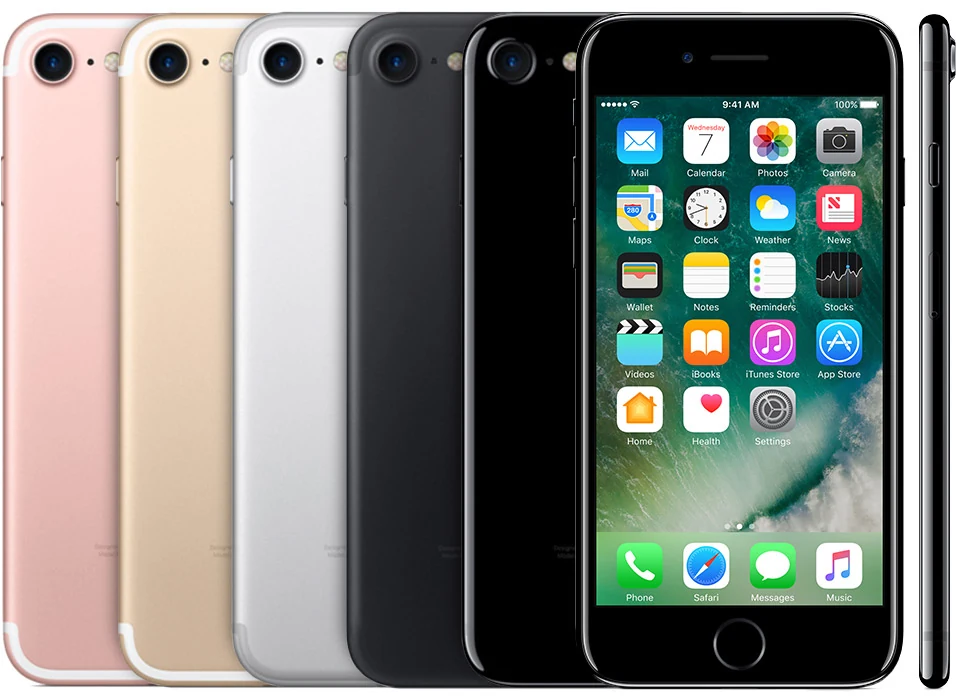
The Home button is no longer a physical, moving button; it’s now a solid-state, pressure-sensitive surface that uses haptic feedback to mimic a click. It takes a moment to adjust to, but it feels precise and responsive. New color options also help the phone stand out. The glossy Jet Black finish is strikingly polished, though it does attract fingerprints easily. For those who prefer a more understated look, matte black, silver, gold, and rose gold are also available.
The phone also earned an IP67 rating, making it resistant to splashes and dust — a first for the standard iPhone. For more hands-on takes, browse our detailed phone reviews.
A Brighter Screen and Stereo Sound — Apple iPhone 7
The 4.7-inch Retina HD LCD display on the iPhone 7 is noticeably brighter and supports a wider color gamut than the screen on the iPhone 6s. While it still runs at a standard 60Hz refresh rate, the improved luminance means better visibility outdoors and punchier colors in everyday use. Another welcome upgrade is the audio experience. The iPhone 7 introduces stereo speakers, with one speaker firing from the bottom and another from the earpiece. Together, they produce significantly louder and fuller sound than the single, bottom-firing speaker on previous models.
It’s not a replacement for dedicated external speakers, but it makes a real difference when watching videos or taking calls. The loss of the headphone jack may be frustrating for some, but Apple’s move to digital audio via the Lightning port — or wireless headphones — is part of a broader shift toward a simpler, more unified port design. For a full catalog of devices, check out the phone directory.
A Chip That’s Fast Where It Counts — Apple iPhone 7
The iPhone 7 is powered by the Apple A10 Fusion chip, a quad-core processor that delivers a noticeable leap in performance over the already quick A9 chip found in the iPhone 6s. The A10 uses two high-performance cores for demanding tasks like gaming or video editing and two power-efficient cores for lighter activities such as messaging or browsing. This design helps the phone balance speed with battery life. In everyday use, the iPhone 7 feels snappy and responsive, with apps launching quickly and animations running smoothly.
For light use, the battery can easily last more than a full day, though heavy gaming or streaming will require a charge before the evening. The 12-megapixel main camera also benefits from the faster processor. It gains optical image stabilization, a wider f/1.8 aperture, and a brighter flash, allowing for sharper low-light photos and steadier video. The front-facing camera has also been upgraded to 7 megapixels.
While the overall design may seem familiar, the changes under the hood make the iPhone 7 a meaningful upgrade for anyone coming from an older model.
A Better Camera That Handles the Dark — Apple iPhone 7
The iPhone 7’s camera delivers the kind of meaningful upgrade that doesn’t require a dramatic design change. The 12-megapixel main sensor gains both a wider f/1.8 aperture and optical image stabilization—features previously reserved for the Plus model. That combination, together with a more powerful image processor, helps capture sharper, brighter shots in low light. Flash performance also improves, with a 50 percent brighter true-tone LED. The result is a camera that feels noticeably more capable in challenging conditions than the one found in the iPhone 6s.
The front-facing camera jumps from 5 to 7 megapixels, a welcome boost for selfies and video calls. And while the iPhone 7 lacks the dual-lens zoom system of its larger sibling, the main lens is strong enough to handle most daily shooting. A side-by-side comparison with the 7 Plus makes clear that Apple reserved the most advanced photographic tricks for the bigger model. But for standard photo and video capture, the iPhone 7 stands on its own as a solid camera phone.
Battery, Water, and the Missing Jack — Apple iPhone 7
The iPhone 7 delivers respectable all-day battery life for most tasks. Under light use—messaging, web browsing, music—it can stretch well beyond a full day. Push it with games or high-resolution video streaming, and you’ll likely need to reach for the charger before bedtime. Apple rates the phone at up to 13 hours of video playback, which is consistent with real-world experience. That said, the included 5-watt charger is slow, so overnight charging is the most practical routine.
IP67 water resistance is a genuine milestone for the iPhone lineup. The phone can survive submersion in up to one meter of water for 30 minutes, though that rating naturally degrades over time. It’s best thought of as protection against accidental spills and splashes rather than a license for poolside photography.The removal of the 3.5mm headphone jack is the most controversial change. Apple includes a Lightning-to-3.5mm adapter, but you cannot charge and listen to wired headphones simultaneously without a pricey dock.
The move is clearly a push toward wireless audio. On the plus side, the switch to a solid-state Home button with haptic feedback feels precise, and the addition of stereo speakers—one at the bottom and one in the earpiece—delivers noticeably louder and better-rounded audio than previous iPhones.
Is the iPhone 7 right for you? — Apple iPhone 7
A Final Look at the Apple iPhone 7
The iPhone 7 is a considered, iterative update that refines many existing features while introducing a few genuine firsts. The A10 Fusion chip provides blazing-fast performance, and the improved camera, brighter display, and water resistance are all meaningful upgrades. Losing the headphone jack is a real inconvenience, but if you’re ready for a dongle or already using Bluetooth, the iPhone 7 is a solid, durable phone that still holds up well for everyday use.
Its design is nearly identical to the iPhone 6s, so it won’t look like a new phone to anyone but you. Storage now starts at 32GB and can go all the way to 256GB, so you have room for apps, photos, and games. If you are upgrading from an older model, the speed and water resistance alone are worth the move. For a deeper look at all the phones we’ve covered, visit the phone finder page.